01
What is temple jewellery?
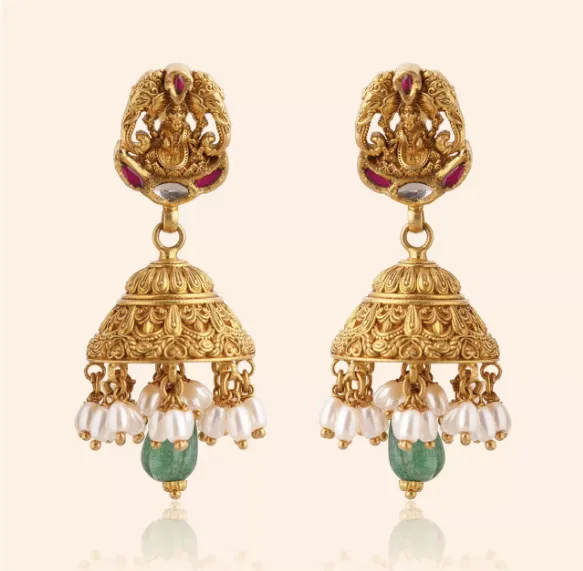
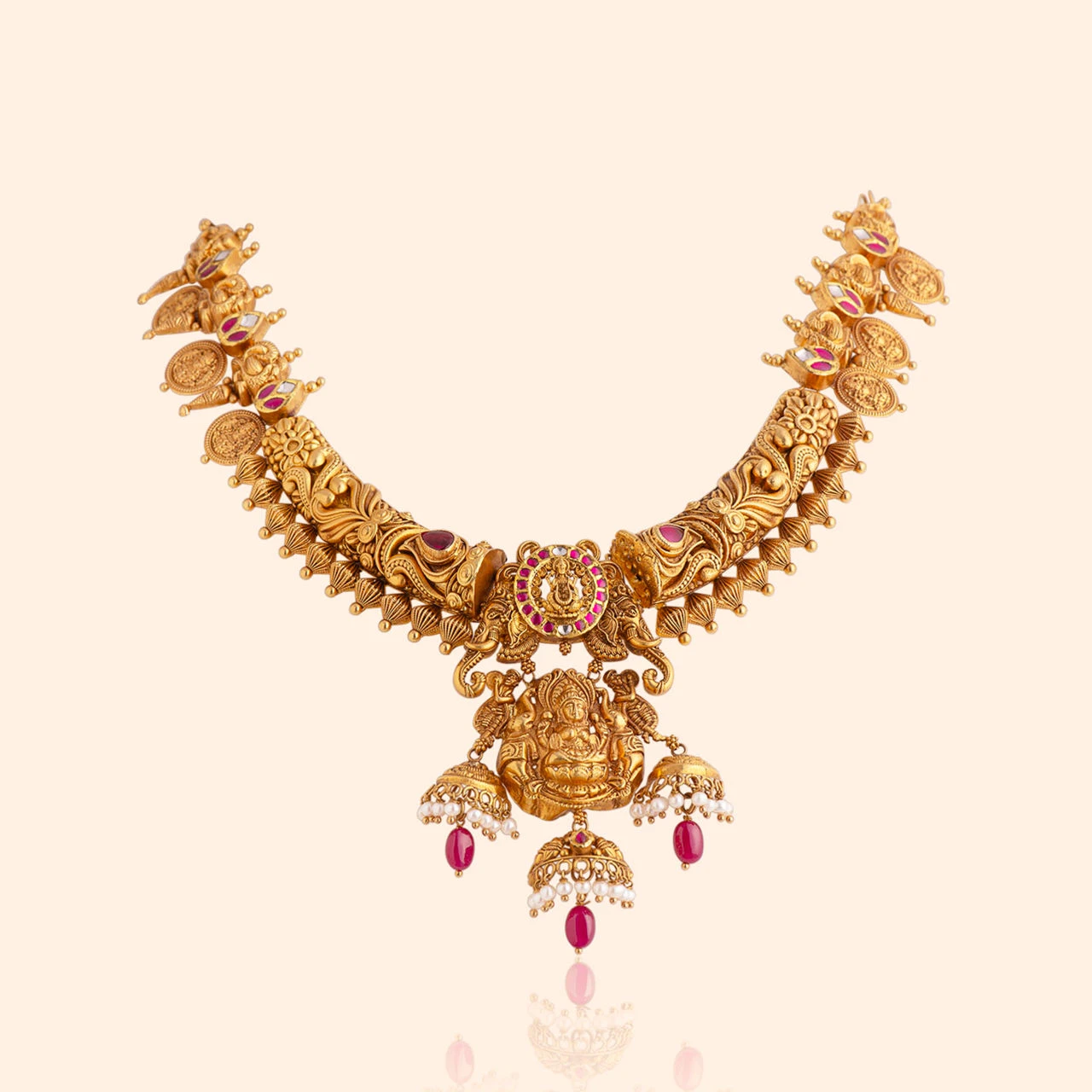
Temple jewellery is South Indian gold jewellery decorated with images of deities, temples and sacred symbols. It takes its name from the ornaments made to adorn the idols in Hindu temples. The designs are raised from the gold by hand in nakshi work, then given an antique finish so they look like the ornaments of a temple deity.
Every piece is a small temple carving in gold: the goddess, her lotus, the peacock at her side.
02
Where does temple jewellery come from?
Temple jewellery comes from Tamil Nadu and grew under the Chola and Pandya dynasties, roughly between the 9th and 13th centuries. Nagercoil, in the far south of Tamil Nadu, is still one of the best-known centres of the craft.
9th–13th century
Made for the temple
Under the Chola and Pandya kings, artisans in Tamil Nadu made heavy gold ornaments to adorn the idols of temple deities, copying the carvings on temple walls and gopurams.
Centuries later
Worn by dancers
Classical Bharatanatyam dancers took up the same designs on stage, which is why temple jewellery is still part of the dance costume today.
Today
Brides and festivals
It is now the signature jewellery of South Indian brides and of festivals such as Varalakshmi Vratham, made across Tamil Nadu, Andhra Pradesh, Telangana, Karnataka and Kerala.
03
What are the common temple jewellery designs?
The three classic motifs are Goddess Lakshmi, the peacock and the lotus. Kasu coins, Lord Ganesha and Garuda are close behind. Each carries its own meaning.
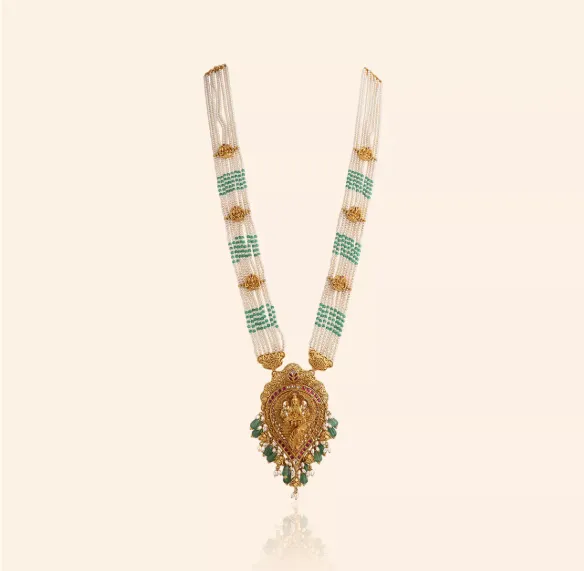
Goddess Lakshmi
Wealth and prosperity. It is the favourite motif for weddings and for Varalakshmi Vratham, the festival of Lakshmi herself.
Seen on: Harams, pendants and the coins of a kasu mala
See the Lakshmi Grace Gold Bridal Necklace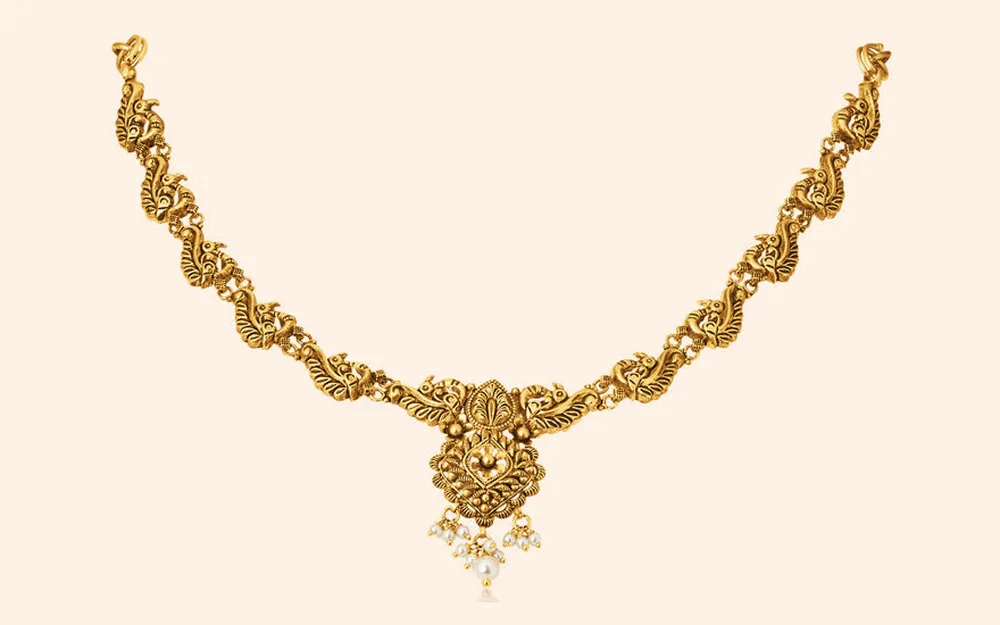
Peacock
Grace and beauty. The peacock is the mount of Lord Murugan, and is often set with red and green stones.
Seen on: Necklaces, jhumkas and hair ornaments
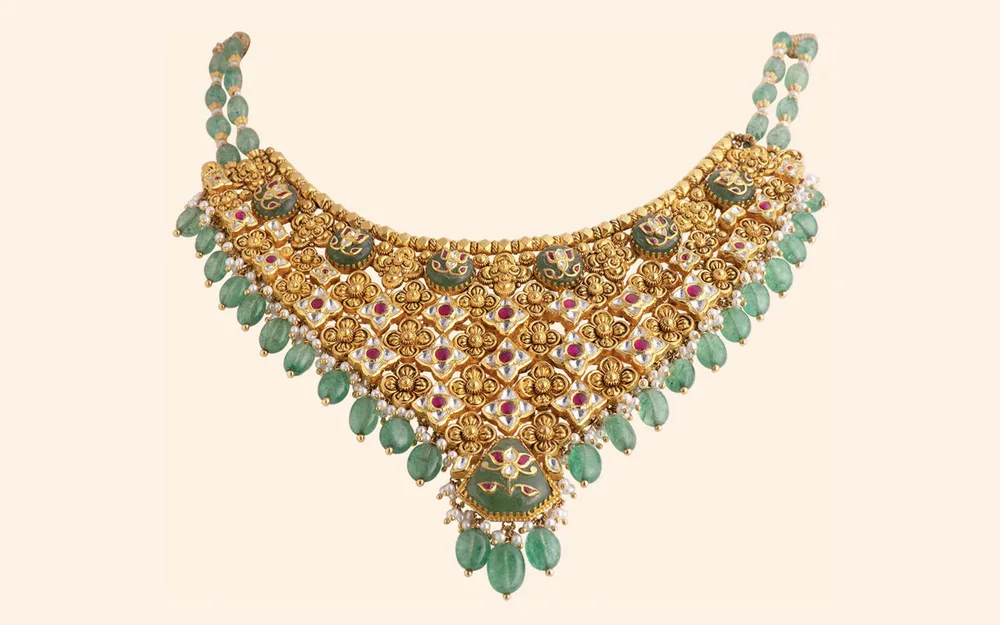
Lotus
Purity. The lotus is the flower Goddess Lakshmi sits upon, so it often appears alongside her.
Seen on: Pendants, bangles and the centre of chokers
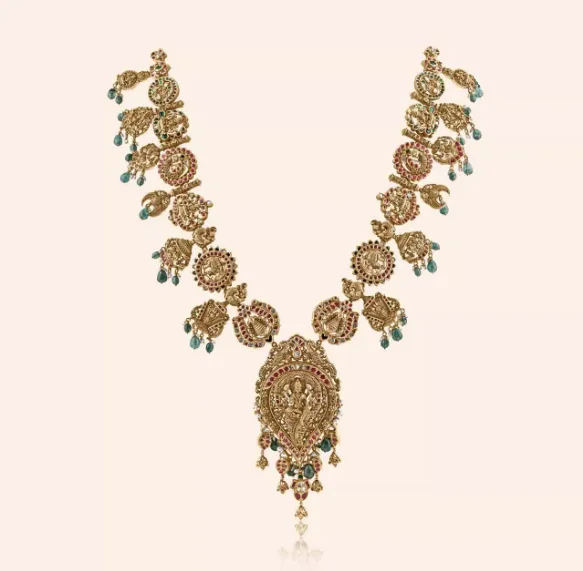
Kasu (coins)
Abundance. Rows of small gold coins, each stamped with Lakshmi, are strung into a long kasu mala.
Seen on: Long necklaces and waist belts
See the Lakshmi Bottu Mala Gold Long Necklace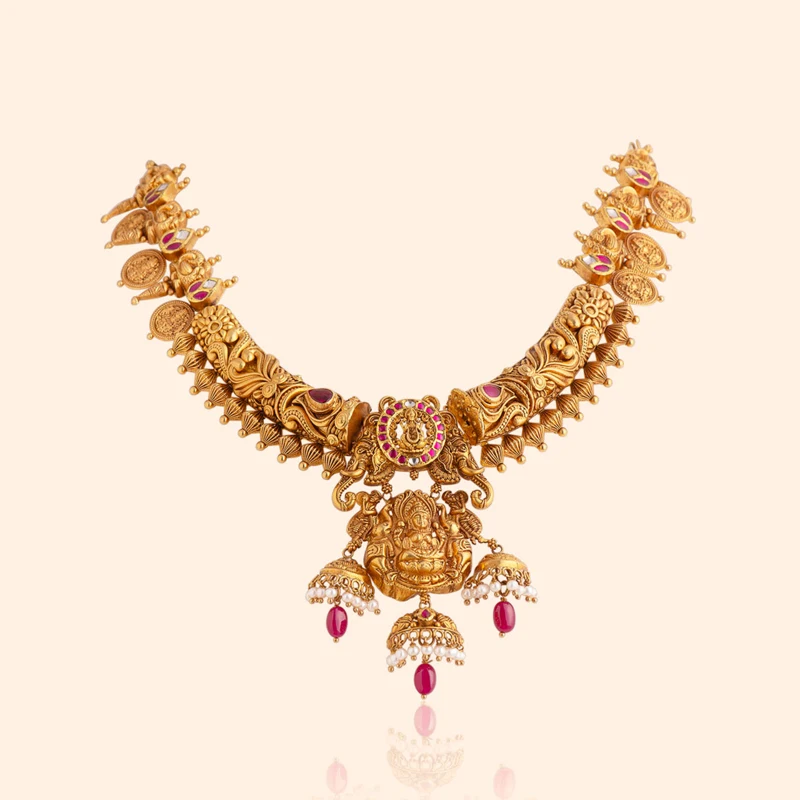
Lord Ganesha
New beginnings and the removal of obstacles, which is why it is a natural choice for a bride.
Seen on: Bridal necklaces and matching jhumkas
See the Heirloom Ganesha Gold Bridal Necklace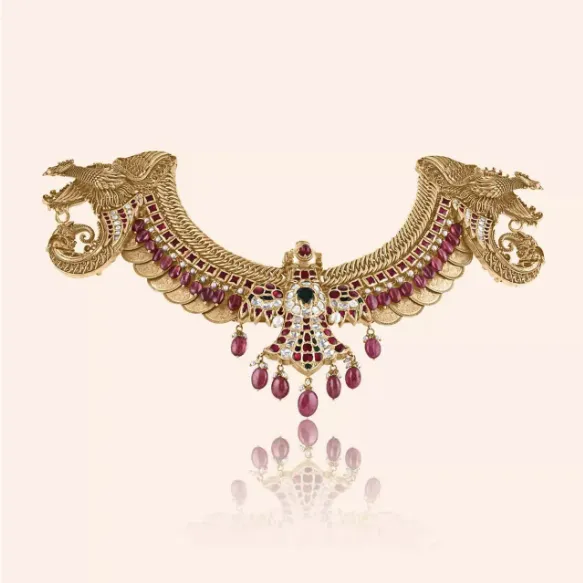
Garuda and gopuram
Protection and devotion. Garuda is the mount of Lord Vishnu; the gopuram is the temple's gateway tower.
Seen on: Short necklaces and pendants
See the Garuda Haar Gold Short Necklace
04
How do you care for temple jewellery?
Temple jewellery lasts longest when it is kept dry, wiped after every wear and stored separately. Six habits keep the antique finish looking as it did on the day you bought it.
Wipe after wearing
Use a soft, dry cotton cloth to remove sweat and oils.
Wash gently
Mild soap, lukewarm water and a soft brush, only when needed.
Dry completely
Pat dry and let it air out before you put it away.
Store separately
One piece per soft pouch or lined box, so nothing scratches.
Add silica gel
A sachet in the box keeps moisture away from the antique finish.
Check once a year
Have stone-set pieces cleaned and checked by your jeweller.
Keep it away from
- Perfume, hairspray and lotions
- Harsh cleaners, bleach or toothpaste
- Ultrasonic cleaners on stone-set pieces
- Wearing it to swim, bathe or exercise
05
Is it real gold or plated?
Real gold temple jewellery carries a BIS hallmark with three marks; plated fashion pieces do not. Every gold piece from Indriya is BIS Hallmarked, so you can check it yourself.
BIS logo
The Bureau of Indian Standards triangle.
Purity grade
For example 22K916, meaning 91.6% pure gold.
HUID
A unique 6-character code for that single piece.
Read more about hallmarking from the Bureau of Indian Standards, or see our temple jewellery FAQ.